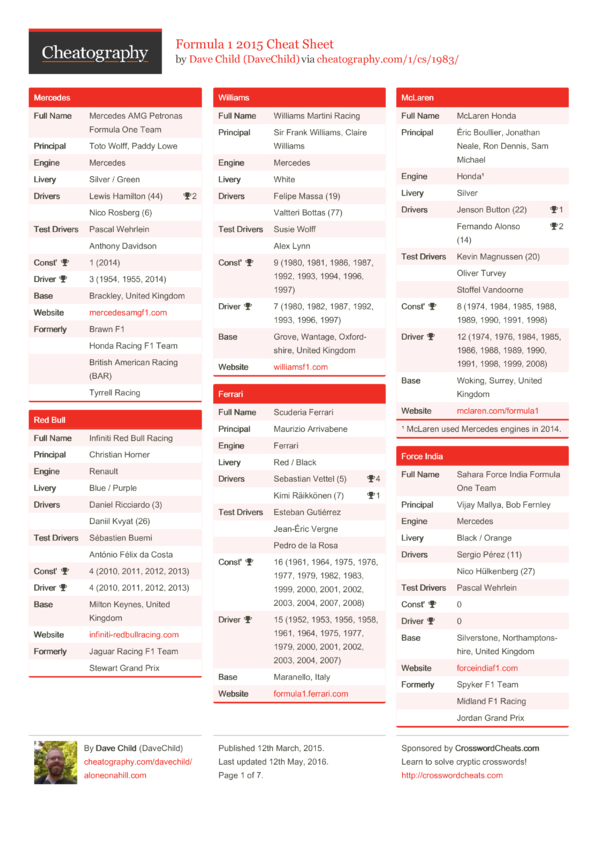
Diving into the thrilling world of Formula 1 can feel like learning a new language. With its intricate rules, advanced technology, and rapid-fire strategies, it's easy for even seasoned fans to miss a beat. That’s where a good formula 1 cheat sheet comes in handy – your ultimate quick reference guide to deciphering the high-octane spectacle. Whether you're a newcomer eager to understand the basics or a returning fan brushing up on the latest nuances, this guide will equip you with the essential knowledge to appreciate every turn, overtake, and strategic move.
From qualifying formats to power unit components and crucial race-day terminology, we’ll break down the complexities into digestible insights. Get ready to go from spectator to informed enthusiast, armed with the lingo and understanding that define the pinnacle of motorsport.
Deciphering the Race Weekend: Format & Scoring
A Formula 1 Grand Prix isn't just a single race; it's a meticulously structured weekend of events culminating in Sunday's main spectacle. Understanding this format is key to following the drama.
Practice Sessions (Free Practice 1, 2, 3)
- Purpose: Teams use these sessions to fine-tune car setups, test new parts, and gather data on tire performance and track conditions. Drivers get familiar with the circuit.
- Duration: Typically 60 minutes each.
- Outcome: No points are awarded, but top times often hint at potential strong performances.
Qualifying
Held on Saturday, qualifying determines the starting grid order for the main race. It’s split into three intense knockout sessions:
- Q1: All 20 cars participate. The five slowest drivers are eliminated and start from positions 16-20.
- Q2: The remaining 15 cars compete. Again, the five slowest are eliminated and start from positions 11-15.
- Q3: The fastest 10 drivers battle for pole position (P1) and positions 2-10. This is often the most thrilling part of qualifying.
Sometimes, a "Sprint Weekend" format is used, which alters the standard schedule by including a shorter "Sprint Race" on Saturday that awards points and determines the grid for Sunday's Grand Prix. Always check the specific weekend format!
The Grand Prix Race
The main event, usually held on Sunday, typically runs for around 305 kilometers (or two hours, whichever comes first). Drivers must complete a mandatory pit stop to change tires, using at least two different dry tire compounds (unless the race is declared wet).
Points System (Drivers' & Constructors' Championships)
Points are awarded to the top 10 finishers in the Grand Prix, and sometimes for the fastest lap, if the driver finishes in the top 10:
- 1st: 25 points
- 2nd: 18 points
- 3rd: 15 points
- 4th: 12 points
- 5th: 10 points
- 6th: 8 points
- 7th: 6 points
- 8th: 4 points
- 9th: 2 points
- 10th: 1 point
- Fastest Lap: 1 extra point (only if the driver finishes in the top 10).
These points contribute to both the Drivers' Championship (for individual drivers) and the Constructors' Championship (for teams).
Key Terminology & Concepts: Speak Like an F1 Pro
To truly appreciate Formula 1, you need to understand the unique vocabulary that commentators and teams use. This Formula 1 Explained: Essential Concepts for Beginners article delves deeper, but here are the highlights:
- DRS (Drag Reduction System): A movable flap on the car's rear wing that, when opened, reduces aerodynamic drag, allowing for higher top speeds. Drivers can only activate DRS in designated zones on the track and only if they are less than one second behind the car in front. It's a key overtaking aid.
- ERS (Energy Recovery System): A hybrid system that recovers energy from braking (MGU-K) and exhaust heat (MGU-H), storing it in a battery and deploying it for extra power. It's crucial for both performance and fuel efficiency.
- Undercut: A strategic pit stop where a driver pits early on fresh tires to gain lap time while their competitor is still on older, slower tires. The goal is to emerge ahead of the rival once they make their stop.
- Overcut: The opposite of an undercut, where a driver stays out longer on older tires, betting that their car performance or track position will allow them to gain time or position after their rival has pitted and they then make their own stop.
- Pit Stop: A crucial moment where the car stops in the pit lane for tire changes, and sometimes minor adjustments. Modern F1 pit stops can be completed in under 2 seconds.
- Tire Degradation: The rate at which tires lose performance and grip. Managing degradation is a major strategic challenge, as different compounds (Hard, Medium, Soft) degrade at different rates.
- Safety Car: Deployed when there's an incident on track that requires marshals but the track isn't completely blocked. Cars bunch up behind the Safety Car, neutralizing the race and often creating strategic pit stop opportunities.
- Virtual Safety Car (VSC): A digital version of the Safety Car. Drivers must slow down to a prescribed delta time, maintaining their gaps to other cars. It provides a safer way to manage incidents without physically deploying the Safety Car.
- Red Flag: Waves when conditions are too dangerous to continue racing (e.g., severe accident, heavy rain). The race is suspended, and cars return to the pit lane.
- Dirty Air: Turbulent air coming off the back of a leading car, which reduces the aerodynamic efficiency of the following car, making it harder to follow closely or overtake.
- Clean Air: Undisturbed air, allowing the car's aerodynamics to work optimally, leading to better performance.
Understanding the Tech: The F1 Car Explained
At the heart of Formula 1 is astonishing engineering. The cars are technological marvels, pushing the boundaries of what's possible in motorsport.
Power Unit (Engine)
Since 2014, F1 cars have used 1.6-liter turbocharged V6 hybrid power units. These are incredibly complex, combining an internal combustion engine (ICE) with sophisticated ERS components. Each driver is limited to a certain number of power unit components per season, and exceeding this incurs grid penalties, adding another layer of strategy and reliability focus for teams.
Aerodynamics
This is where much of an F1 car's performance comes from. Wings (front and rear), bargeboards, diffusers, and the car's overall shape are meticulously designed to generate maximum downforce (pushing the car into the track for grip) while minimizing drag. Teams constantly evolve their aerodynamic packages throughout the season.
Chassis & Monocoque
The car's central structure, or monocoque, is a carbon fiber composite shell that houses the driver and fuel tank. It's incredibly strong and light, providing paramount safety for the driver in the event of an impact.
Tires
Supplied by Pirelli, F1 tires are critical for performance and strategy. There are typically three dry compounds available per race weekend (Hard, Medium, Soft), plus Intermediate and Wet tires for rainy conditions. Understanding their wear characteristics and optimal operating temperatures is vital for race engineers and drivers.
Strategies & Tactics: The Chess Game of F1
More than just raw speed, Formula 1 is a strategic battle fought by engineers and drivers. Every decision, from tire choices to pit stop timing, can determine the outcome of a race. For a deeper dive into the nuances of strategy, check out Mastering Formula 1: An Ultimate Cheat Sheet.
Tire Management
One of the most critical aspects. Drivers must push hard enough for pace while preserving their tires to avoid excessive degradation. This involves finding a delicate balance and communicating constantly with their race engineer about tire condition.
Pit Stop Strategy
Teams plan their pit stops based on expected tire degradation, track position, and the strategies of their rivals. Factors like safety car deployments or unexpected rain can force a complete overhaul of the initial plan.
- One-Stop Strategy: Usually involves a longer stint on one set of tires, then a switch to another. Less time in the pits, but potentially slower on track.
- Two-Stop Strategy: More common, allowing for shorter, faster stints on fresh tires, but more time lost in the pit lane.
- Three-Stop Strategy: Aggressive, requiring maximum pace on shorter tire stints, often used when tires degrade quickly or a driver needs to make up significant ground.
Fuel Management
While cars no longer refuel during races, managing fuel usage is still important. Drivers might "lift and coast" (release the throttle early and coast into corners) to save fuel, especially towards the end of a race, without losing too much time.
Overtaking vs. Defending
Drivers constantly weigh the risks and rewards of making an overtake versus conserving tires or defending position. Key overtaking spots often include the end of long straights or heavy braking zones, sometimes aided by DRS.
Understanding these strategic elements transforms watching an F1 race from a simple speed contest into a captivating game of chess at 200 mph, with drivers and strategists making split-second decisions that can turn the tide of a championship.
Conclusion
The world of Formula 1 is a vibrant tapestry of speed, technology, and strategic genius. This formula 1 cheat sheet aims to demystify its core components, providing you with a solid foundation to understand and appreciate the sport. From the precise choreography of a race weekend to the cutting-edge technology beneath the hood and the intricate strategies playing out on track, every element contributes to the breathtaking spectacle. Keep this guide handy, and you'll soon be speaking the language of F1, ready to enjoy every moment of the greatest show on earth.